Sunday, February 3, 2019

Star Trek Discovery & A Conservative Trek Fandom

Related image

         Star Trek fans were given something they'd been hoping for 12 years on September 24th, 2017. This was the premier of Star Trek Discovery. Sadly, those hopes were quickly dashed with a poorly executed public presentation. Discovery was launched more or less as a commercial to draw in subscribers to the CBS network's streaming service CBS All Access-with no other way to view the show in North America as new episodes aired. Among a litany of other creative matters happening internally, Discovery has proven by far the most controversial Star Trek series I've personally ever seen. A major part of that is a sudden emergence of something that would seem to be an oxymoron: conservative Star Trek fans.

           As of this writing, I've seen the entirety of Discovery's first season through my boyfriend's Blu Ray copy. And the first episode of the second season which has been posted on YouTube for free. The series is told from the point of view of Sonequa Martin-Green's Michael Burnham. She winds up being the science specialist on the Crossfield class starship U.S.S. Discovery during a war with the Klingon empire and an accidental journey to the mirror universe's. This all relates to the ships problematic spore drive, which can allow it to materialize instantly anywhere and space and maybe even time. It takes place a decade before the events of TOS. And does so in a glossy, fast paced manner close in appearance to the Kelvin timeline Star Trek movies of 2009-2016.

          So where does a conservative fandom play into all this? Discovery has been consistently accused of going strongly against well established Star Trek cannon-both thematically and visually. And its hard to disagree with that. However many viewers of the show have complained that the Michael Burnham character, combined with the progressive social attitudes of Sonequa Martin-Green, is promoting an "SJW agenda". SJW standing for a social justice warrior. And according to this viewpoint, Star Trek's previous incarnations from 1966 onward did not. As my friend and YouTuber Steve Shives pointed out, Star Trek itself was based in Gene Roddenberry's social justice interests. So what ways could a conservative Star Trek fandom such as this have ever developed?

           The first reason for conservative Star Trek fans could be based in a superficially ironic fascination. In the mid 1990's, William Shatner himself sometimes described Star Trek's socially conscious story telling as a means for the writers and producers of the show simply to draw in an audience. This in turn led producers to pursue a less story and more action oriented version of Star Trek-at one point even coining the 1996 Trek movie First Contact as "a Star Trek film for people who aren't Trek fans". The result ended up in an audience that viewed Star Trek itself as merely a campy, gimmicky form of entertainment that wasn't enjoyed for genuine, serious reasons by many people.

          Another reason has to do with theatrical tropes in film and television since the mid 90's. dystopian cautionary tales have always been part of science fiction in these mediums. Perhaps due to the decaying pop culture zeitgeist of the late 90's and early 2000's, dystopian futurism suddenly became the mainstream of science fiction. This has also tended to define original content during the first decade of streaming services. That leaves the lines between horror, psychological thriller and science fiction bleeding together. Its possible that this notion of the future being something to fear might cause modern sci-fi fans to become convinced that happiness and security can only exist by fully embracing the past. And that is the very definition of conservatism.

         This conservative notion of idealizing the past might relate to all the Star Trek related projects of the 21st century so far being prequels. From the premier of TNG in 1987 to the premier of Voyager in 1995, each Trek series leaped a period from decades to years into its own future. And that allowed changes in contemporary reality to have a stronger impact on each spin off of that era. Starting with Enterprise in 2001, events such as post 9/11 censorship and the subsequent Viacom split (both having their own conservative back rounds as well) resulted in Enterprise basically being the beginning of the downfall of Paramount's UPN TV network. And the following Kelvin timeline films nearly bankrupting Paramount itself after its third such Trek film.

           Discovery as a series not only deals with both an ironic interest in Star Trek. And the results of excessive dystopian sci-fi. But also, as with Star Trek of the past, mirroring the times around it in its own way. The 2010's found American trying to heal from the scars of that post 9/11 era. And a subsequent war that resulted in thousands of disabled veterans with with limited health care. Or totally lacking in it at all. Then a fascist end of the right wing has forced the people the US to embrace changes in attitudes towards gender equality, multiculturalism and civil rights at an extremely rapid rate-often more than most human beings could handle. So Discovery's human stories of PTSD, childhood trauma and romantic disillusion reflect all of this as its a part of our reality.

          The fundamental aspect of how reality of our lives effects Star Trek Discovery is changes in gender roles and understandings. Two of Discoveries male characters, scientists Paul Stamets and doctor Hugh Culber are in a same sex relationship. And security chief Ash Tyler has been a victim of human experimentation by Klingon's-leading to emotional/mental instability and vulnerability. The quality of vulnerability has been historically viewed as a weakness in the male gender. And with both the pro and anti group on male vulnerability now in conflict in US society? That has turned conservative Trek (who generally seem to be male) fans against other Trek fans who are not. This conflict has eroded not only the Trek fandom's internal interactions. But how it views Trek itself.

          Star Trek has for over half a century represented the human condition. That has been a mainstay of its fandom since Gene Roddenberry first created it in the mid 60's: people seeing themselves and the society around them in Trek's often topical storytelling. This has not always been true of the shows different creators. Increasingly, the Star Trek universe as become diminished in favor of the term "Star Trek franchise". This essentially completely monetizes what Star Trek functions as in society. And takes its characters and stories out of the hands of truly creative people. And results in all of them becoming a commodity. In the end, that puts Star Trek itself on the road to becoming yet another cultural adjunct of the fiscally conservative philosophy.

           If Discovery is not Star Trek in the way someone such as myself recognizes it, perhaps that's because Star Trek cannot exist in this time. Discovery has emerged when the conservative Star Trek fan, budding for decades, is in full flower. This conservatism is similarly noticeable among current Doctor Who fandom as well. Perhaps the solution to Discovery's current woes are not merely in writing/production choices. But in the fact that these creators and fans of Trek might want to rethink their motivations for being interested in Star Trek. To see if Trek's meaning truly suits their understanding. Then, perhaps, fans and show creators might be able to come together to create a new and stronger Star Trek TV series to inspire future generations in this frightening, uncertain age.



Thursday, September 28, 2017

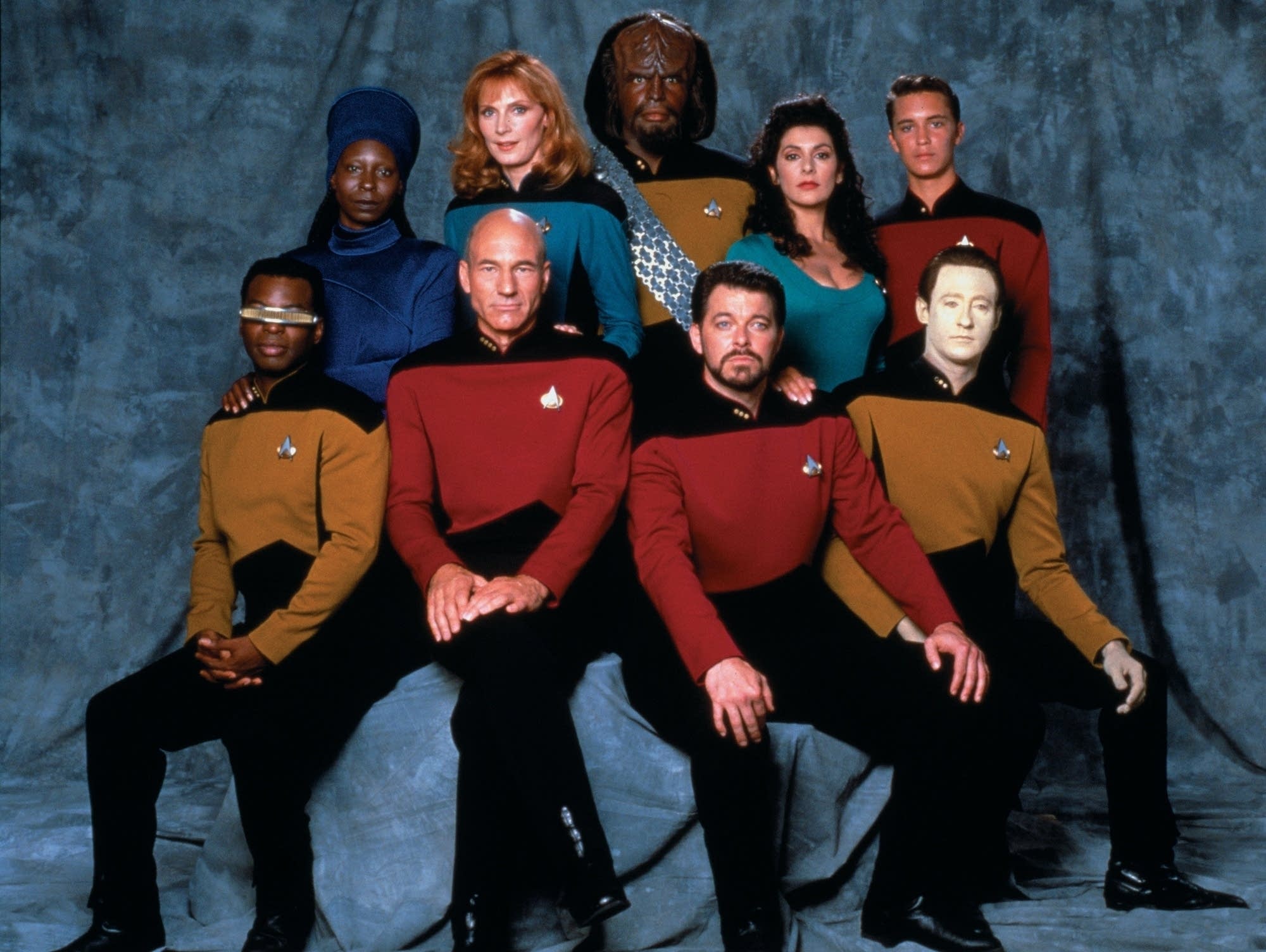
Star Trek-The Next Generation At 30: Boldly Going Where No One Had Gone Before


Star Trek: The Next Generation pulled off something that was probably considered impossible. It showcased that Star Trek was not a concept dependent on simply one set of characters. Still hard for me to believe that before September 28th,1987, there was only on Star Trek cast. One Star Trek TV series. And that extended into the movies as well. I personally first heard of Star Trek: The Next Generation  via a preview on the family's VHS copy of Star Trek IV: The Voyage Home. The preview went out of its way to showcase the characters. In particular LeVar Burton as Geordi LeForge, whom the preview described as "a man with unique vision". I knew LeVar from PBS's Reading Rainbow, a favorite of mine at the age of 7. The idea of him playing a blind navigator on this show excited me.

TNG's premier episode "Encounter At Farpoint" was going to be airing on a Monday night. I was in first grade then. And my bedtime was about 8:30-9PM. It took some soul searching on my parents part. But I was allowed an 'exception" that night, a word my parents both used referring to a deviation from my typical bedtime. Recall actually falling asleep at the tale end of the episode. But remember being fixated (at age 7) on this world with this omnipotent entity Q pursuing the Enterprise, putting Captain Jean-Luc Picard and his crew on trial for humanities crimes, Q freezing Lieutenant Tasha Yar for vocally resisting him. And finally two jellyfish like aliens being reunited as lovers in the end. It was all the buzz the next day at school-with many having a similar experience to mine.

Closure to this experience came at a Bangor, Maine Sci Fi show two years ago. I couldn't pay anyone for autographs, much to my bewilderment. One of the sci fi stars there was Denise Crosby, who of course portrayed Tasha Yar in TNG's first season. I told her the same story that was just written in here about how I first saw the series. Crosby was genuinely touched. And gave me a big hug, thanking me for sharing the story with her. Its an experience I'll never forget.. What I did not tell her was of the many different opinions of the show from when the show first aired. Both my mother and the school phys ed teacher at the time were very faithful to classic Star Trek in 1987. My mother for her part felt it was "too much flash". And disliked Captain Picard's "by the book" attitude.

By the early 90's, TNG had swiftly become part of Sunday night family viewing in my household at 6PM. Afterwards was the show Life Goes On. Watching the android Data learning about humanity mimicked my (and likely many other) preteens experience learning of their own world. And the morality plays and social issues brought up by the show gave TNG two important qualities. It served to make it excellent,thrilling entertainment. But also showcase how humanity could learn from its own mistakes. And keep on striving to do better. At the time, it all felt like a morality that asked only to learn from it. No blind devotion, no murder in its name. Just entertaining futurism and morality plays on important life lessons.

This overview of Star Trek: The Next Generation might seem overly personal to some. Perhaps even egotistical. Yet as the saying goes, the personal is political. Have always lived knowing that this show has generally had a positive effect on everyone whose ever consistently watched it. While 1990's era cynicism cast a lot of doubt on TNG's scientific plausibility and some of its characters (in particular Wesley Crusher and the empathic counselor Deanna Troi), TNG represents an excellent standard for what a Star Trek series could be. It allowed Trek to endure outside the trappings of its original cast. It gave Star Trek its own future. Its own timeline. And made the Trek future (at least something close to it) something look forward to. And that's what TNG means to me as it turns 30.


Tuesday, December 6, 2016

Star Trek VI: 25 Years Of The Undiscovered Country

            Star Trek stood by itself 30 years ago. There was only one Star Trek,with one cast of characters. Then a year later, Star Trek: The Next Generation came along. During seasons 4 and 5 of that show,Star Trek as a whole celebrated its 25th anniversary.1991 was also the year where I went to my Star Trek convention-the only one my area ever put on,met actress Nichelle Nichols and got a chance to go to the theaters to see my second Star Trek movie on the big screen. That movie was Star Trek VI:The Undiscovered Country. Whats interesting about today is that this movie itself is now currently experiencing its own 25th anniversary.

                The Undiscovered Country was announced amid a rumor mill that I'd heard play out at a local comic store called The Wizards Den.  One thing that was known about the film was that it was going to be the final film to feature the entirety of the original Star Trek cast. Another story (which thankfully turned out to be total rumor) was that the entire original crew of the Enterprise would be killed off in the film. As with most Star Trek films made after 1984,the films production had an air of secrecy. There were a few things I did now based on info included in the Star Trek 25th anniversary special.

                  Those two realities of the film were that The Undiscovered Country would involve Klingon's. And that it would be a who dunnit. That turned out to be something of an understatement. The story involves a reluctant James T Kirk (and the crew of the Enterprise) being accused of attacking a Klingon vessel (and murdering Chancellor Gorkon,who was on board) at the dawn of peace negotiations following due to a disaster crippling the Klingon's energy resources. Solving this mystery unravels a conspiracy within both the Federation and Klingon empires by those who'd stand to lose from such a peace between the two societies.

                   Star Trek has always functioned best as sci fi social allegory paralleling current events on Earth within its universe. The Undiscovered Country's plot about a Klingon energy production facility called Praxis exploding and the need for a mutually beneficial peace paralleled the relationship between America and the Perestroika era USSR following the Chernobyl disaster. Director Nicholas Meyer had a big role in this element of the story. Using the character of General Chang (played by Christopher Plummer),he inserted his love of Shakespeare by including elements of The Bard's Hamlet into the story. That includes the title of the film itself.

                      One thing that enhances the films story is the memorable characters. Even ones who were only to appear in the film. A young Kim Cattrall appears as the Vulcan Lieutenant Valeris. Her interactions with Spock and the crew during their investigation of the Klingon/Federation conspiracy make her so endearing and memorable,one might be sad she winds up the villain of the piece. Still though,a villain of some complexity. Same goes for Christopher Plummer as the pompous General Chang. Iman makes an appearance as the clever and treacherous shape shifter Martia. Who actually provides Kirk with an interesting (if brief) prison love scene on the icy penal colony of Rura Penthe.

                        James Kirk himself is a major plot point during this film. Spock volunteers him for a mission to meet Chancellor Gorkon's ship as an escort to a peace conference. The humorous send up is Spock quoting the Vulcan proverb that says "only Nixon could go to China". Kirk is presented as a man who distrusts Klingon's due to the death of his son. The behavior of the racially diverse crew members of the Enterprise during an awkward state dinner with the Klingon's  indicates that,while humanity has solved its own issues with bigotry,that they would still need to take time to deal with alien races with very different values and cultural traits than humanity.

                         Michael Dorn,who portrayed Worf in Star Trek The Next Generation also appeared in the film as his characters grandfather. This character was an attorney pressed into service to defend Kirk and Dr.McCoy during their murder trial on the Klingon home world of Kronos,which actually gets its official name in this movie. Also,this is also the first Star Trek to feature any characters dealing with problems associated with zero gravity. After the attack on Gorkon's ship,the gravity is knocked out. And this provides an opportunity to set up the assassination plot that characterizes the film.

                           In the end,I view this as one of the original Star Trek films that got everything completely right. It had memorable side characters,plenty of what the late DeForest Kelly referred to as "Star Trek moments" relating to its type of humor,very magisterial action sequences filled with manic Shakespeare quotations and (most importantly to me,anyway) some of the best and most topical senses of social commentary in a Star Trek film. At the end of the day,its about the contrivances some will create in the face of their fears of change. And that comes together to make this one of Star Trek's finest theatrical moments.


Tuesday, November 29, 2016

Star Trek-First Contact: A 20th Anniversary Perspective

        Star Trek-First Contact celebrated its 20th anniversary one week ago today. It was a film that had a great deal riding on it. It would be the first motion picture to fully showcase the characters from Star Trek-The Next Generation. Not only that,but the events of the previous movie Star Trek-Generations necessitated the design of a brand new Starship Enterprise. Specifically NCC-1701-E. The movie's creators Ronald D. Moore and Brannon Braga (at the time working primarily on UPN's Star Trek-Voyager) also decided that the plot of the film should focus around the TNG era of Star Trek's most frightening nemesis: the Borg. 

The plot of the movie dealt with the new Enterprise E and its grew travelling back in time when a Borg vessel used a time vortex to assimilate humanity in its past-following an invasion of Earth that Starfleet had thwarted. The Borg had gone back to stop first contact,humanity's initial contact with an extraterrestrial species,the Vulcan's,following the first faster then light speed interstellar voyage by Zefram Cochrane. Through some interference on the part of the Enterprises's crew,the Borg's attempts to stop first contact are successfully stopped. And Cochrane,though initially reluctant,does make his warp flight before the Enterprise crew return to their now restored timeline.

All of the events that led up to the Star Trek universe had been the topic of many commercially released novels and fan fiction about the show prior to this movie. The character of Zefram Cochrane was even introduced in the original Star Trek TV episode "Metamorphosis". James Cromwell portrayed the role of Cochrane in this film. He is the catalyst for the movie's events. Not only that,but he was also the central element of the movies most enduring theme: what motivates idolatry. The crew of the Enterprise view Cochrane as a heroic figure from their time period. Cochrane himself is a damaged cynic who views his first warp speed flight as a chance to make his personal fortune.

One excellent character in the film is the wise and calculated astro physicist Lily Sloane,portrayed by Alfre Woodard. Her level head and no nonsense manner balance out the extreme actions of Captain Jean Luc Picard in the film. And that's a good lead in to my personal observations of the film. When First Contact's trailers were first shown on television in the summer of 1996,they came across as disappointing and unappealing. In fact,there was a long period where I had absolutely no interest in seeing the movie. My parents convinced me to give it a chance. After seeing it,my opinion was downgraded. However,time has given far more clarity to those angry and disappointed thoughts.

First Contact was actually one of the TNG era casts most successful films from a strictly commercial standpoint. However,the weakness I observed in the film is best summed up by what BBC film critic Emily Carlisle said of the film at the time. And that was that it was a more action and less character focused film than the majority of Star Trek movies. Even objectively,I'd have to look at the mid 1990's to try to explain some of this. At this point,the subersive and underground "mean people" culture of the 1980's had come into the mainstream of pop culture. In this highly sarcastic culture,Star Trek was often snidely referred to as a retro (even campy) joke from an idealistic past.

Star Trek in general was experiencing its 30th anniversary the year First Contact came out. And I was deeply involved in the literature about the writing and development of this film. Its creators made no bones about wanting to create a film for a more modern (and presumably less cerebral) audience. So in the film,the Borg are more overtly hostile and horror movie zombie like in nature. Also,Jean Luc Picard is almost totally out of character as a vengeful character acting more like Rambo,with an enormous dose of PTSD. Not to mention jokes about the normally gentle Counselor Troi getting drunk simply to curry favor with Zefram Cochrane.

As with any film,its all a matter of taste. I personally felt it represent the beginning of Star Trek's downfall. And still do now. A good part of that has to do that its action/catch phrase based nature essentially laid the groundwork for J.J. Abrams' modern day Star Trek reboots. So if someone loves Star Trek for its wit,characters and futuristic social commentary,this film really offers little for such an audience. If one views Star Trek as action driven sci fi in need of cultural updates to suit changing trends,this movie might just be for you. With Star Trek just about to reemerge from its 11 year slumber on TV in May of 2017,First Contact may eventually come to be seen a bit differently.

Wednesday, September 7, 2016

Star Trek's Golden Anniversary: Boldly Going To A Future Where No One Has Gone Before


Tomorrow will be a very special day for admirers of Star Trek. It'll be the 50th anniversary of the original series of the show first airing on NBC. There has been some vital Trek related events this year. The first was the third edition of the still controversial reboot movie series staring Chris Pine called Star Trek Beyond-which as of this writing I have yet to see. Even more exciting is the announcement of the first Star Trek TV series in over a decade to be premiere early in 2017. Trek alumni Bryan Fuller and Nicholas Meyer will be prominently involved in its writing as well.

Personally, I don't think there's much to say about Star Trek that isn't well known to many. Especially in the post 9/11 world,much of which has been devoid of any new Star Trek on TV,the shows ability to entertain and enlighten with vital science fiction concepts and a socially progressive message is actually becoming a lot more seriously understood than it was in my own personal generation. So to celebrate Star Trek's 50th anniversary,I'm going to run down the pros and cons about Star Trek's production and impact on society. It will be rather subjective. But you may still find some universal truths in it too.

Trek Pros:
*Seeing racial equality and understanding as a strength. This point was brought up by YouTube columnist Steve Shives on his list video about Star Trek. Its also somewhat ironic that another YouTube user I'm aware of pointed out the need for Star Trek in current society without realizing it. And all by this person stating that racial diversity was actually a huge weakness.

*Star Trek has provided us with many unique scientific concepts. It practically invented the cell phone,the smart phone and the internet tablet. Not to mention the ideas of tricorder's,phasers,
holodecks and food replicators all being studied as possible future technologies. Have to wonder when humanity will be able to handle the invention of Isaac Asimov's positronic brain that Data had in Star Trek The Next Generation.

*During times when the positive social changes of the 1960's were being challenged by regressive and theocratic politics,Star Trek remained in existence in some form to remind its viewers not to give into cynicism. That the future could be hopeful,productive,full of new adventures and even humor.

Trek Cons:
*Taking Star Trek out of syndication. After the negative personal experience Gene Roddenberry had the original Star Trek series,the following two spin offs The Next Generation and Deep Space Nine were sent straight to syndication. And became very successful. The next spin off Voyager launched the now defunct UPN (United Paramount Network).

That series popularity faltered some. After the failure of its followup prequel Enterprise in 2005,the series ended and took UPN with it. There has not been another Star Trek spin off on TV since. With much of the upcoming new series set to air on CBS's new streaming channel All Access,one can only hope the people in charge will soon learn the lesson from the terrible mistake of making Star Trek exclusive to a specific network.

*Star Trek being considered cheesy. I was in adolescence in the 1990's. So this part may be the most subjective. As early as the mid 80s,stand up and skit comedy began depicting some of the acting and low budget effects of the original Star Trek. This often led to Star Trek being seen as "wonderful cheese" or some other such thing,even within its own fandom. Luckily after the demise of the prequel series Enterprise,this attitude began to change. And most people began to realize how significant Star Trek was socially and to the world of technology.

*Star Trek post 9/11. Realize this was already hinted at. But while its true any long running TV show (including spin offs) needs its breaks to keep from growing stale,Star Trek's decade off TV after 2005 was a gaping loss. When reality was dominated by reminders that many of the 60's social changes in race,sex and politics were not yet fully resolved,I personally cannot think of a time when something such as Star Trek,with its implicit social commentary,was more needed.

So there's the basic pros and cons to Star Trek. They don't apply that much to the actual content of the show. But more so to how Star Trek has been presented at different times. Its a happy decision to see that Star Trek has such a strong,positive and above all more well rounded understanding with people today. Even the satire of it is more affectionate so it seems. Now as it is about to return to the small screen,Star Trek can harness its great cultural power and influence to help humanity boldly going to the future it really could use to go to.


Steve Shive's YouTube Video '5 Awesome Things About Star Trek'

Friday, February 27, 2015

Leonard Nimoy:1931-2015

                                       This morning after breakfast I had the great misfortune of learning that actor Leonard Nimoy-famous for,among many things,for his portrayal of famous half Vulcan/half human (and American television icon) Spock throughout the Star Trek saga. He passed away of end stage COPD this morning at his home in Bel Air at the age of 83. In this day and age? The idea of a someone from America's silent generation passing away should not shock me. But I am not a cynic. I am a full blooded human. And it does have an emotional effect on me.

                                    One of the things that fascinated me most about Nimoy and his famous character over the years is how much he said for anyone (such as myself) of an overtly biracial heritage. In his case? Spock was a character who basically had an emotionally based half (human) and a logical based half (Vulcan). And Nimoy made sure to infuse his character with that duel nature as his core element. And through 79 original Start Trek episodes, six motion pictures plus guest appearance in Star Trek The Next Generation and JJ Abrams' two relaunch Trek films? Nimoy never lost sight of Spock's depth of duality.

                                     There are those two ways to view the man's passing for me. The emotional human way would be that the character of Spock was representative of me growing up being able to see different people as creatures of death,not merely hollow shells of mostly water just living to die. On the logical Vulcan level? That would best be expressed in a line Nimoy himself voiced,speaking to his younger self as Spock in the animated Star Trek episode 'The Infinite Vulcan'.  He explained how logic would enable one to face death without tears-by understanding that all life comes to an end when time demands it. In closing I would like to wish my deepest sympathies to Nimoy's family,co-stars and close friends for the loss of this talented actor,director,poet,singer and (as I learned a decade ago) photographer. Live long and prosper!


Friday, February 14, 2014

Star Trek And The Communist Connection: My Outlook On An Apparently Popular Conspiracy Theory

            Star Trek has been completely out of circulation in terms of delivering new television episodes for nearly a decade now. One possible reason I've made mention of previous to this is that after 9/11,society in general changed. There came a paranoia of a kind seldom seen since the height of the Cold War in America. In terms of immigration and tolerance of the Muslim faith in particular,the general world stage became increasingly exclusionist. A science fiction television show that celebrated optimism and humanity simply had no place in such an environment. Yet there was perhaps something deeper in Star Trek's absence. Something that ironically threw back to what was actually a prime period for the show in general.

            Having spent my adolescence during the 1990's,I can say from personal experience that it was a time where genuine cultural education played second fiddle to conspiracy theories. There were many-ranging from President Kennedy's assassination to whether or not George Washington chopped down that cherry tree. In the "keeping it real" era,tall tales were suddenly viewed with suspicion. One of these conspiracy theories I was personally exposed to even before the advent of the internet was that the Star Trek universe was a communist one. Two possible reasons were presented. One was because of Gene Roddenberry's left wing political views. And also because in the future Star Trek presented,money no longer existed.

             Being an American of course,I am of course very much a child of capitalism. I am a consumer and therefore benefit the economy. However I am also of the last American generation to have some memory of the Cold War-albeit the time of Perestroika  to be specific. So my understanding of American democratic capitalism is fairly well rounded. However all I'd ever heard of Communism was the basics,as well as Cold War era propaganda from both sides which ultimately said nothing. So based on my more well rounded knowledge of Communism-as envisioned by Karl Marx and of course my knowledge of Star Trek,I'd like to make an attempt at breaking down the facts and fiction of this matter. Well,the science fiction of it anyway.

             In the most basic terms,my personal conclusion is that Star Trek doesn't advocate or represent Soviet era communism. In fact in the debut episode of Star Trek The Next Generation Encounter At Farpoint, Jean-Luc Picard refers to the 20'th century principles of capitalism and communism as being "nonsense that's centuries behind us" to Q. This points to the principles of Star Trek as being related to neither political party. That being said its also important to remember that Star Trek is set in the 23'rd and 24th centuries. Its no doubt to me that on a sociological level,human beings of that period would look upon both said political parties much the same way as we'd view what was stated in The Mayflower Compact as it would apply to the current US constitution.

                 That brings me to the next level of all this in Star Trek's difference in perspective. Many of us course look back at the Salem witch trails today with the same disgust and embarrassment that the characters in Star Trek look upon some of the competitive militaristic intrigue of our real life society. That in fact points to the very function of Star Trek on a sociopolitical level for its admirers: showing our absurdities through the mirror of our possible future. In the Star Trek universe? There is no poverty,technology had genuinely eliminated the need for possessions and the United Federation Of Planets emerges as a mostly functional social  democratic  organization that,all the same embraces contemporary military ranking and hierarchy. So does any of these relate the fictional Federation to...say Soviet communism?

                   My answer to that is absolutely not. Originally Soviet type communism was a proletariat,one party despotic dictatorship which used humanistic ideologies to create classicist political descent in the developing countries it intended to overtake. Once massive revolutions around matters of economic and civil rights had finally overthrown said nations own government,the Soviet's then took complete power-creating an atmosphere of eugenics-through-terror where the Utopian ideologies were a mask for massive crimes against humanity. And,in fact communist governments ended up being as based in prejudice as their nemesis's despite their dogmatic approach to revolution.As a result,today just about anyone with a social democratic/humanist political leaning is considered to be a communistic oriented individual. In The Star Trek universe there is a world government on Earth-actually a more elaborate United Nations representing many different political systems.

                    The simple reality of Star Trek's political atmosphere doesn't relate to capitalism,no. Nor does it relate to communism. Terms such as "sold","money" and other phrases that a contemporary Communist party member would never use are used alternately by various Star Trek characters in its long history. What may sway some into thinking Star Trek presents a pro communist view of humanity's future is its strong sense of justice for the rights of,in their case,all sentient and intelligent life. The values of racial respect,sexual and educational equality were all a part of the communist ideology. But in that case were used in a totally dishonest fashion.  Star Trek presents a universe where the talk of our time,as it were,is actually put into action. And the best part is humanity still presents itself as fallible in the future,even to despotism in that future. That's what makes Star Trek's vision wonderful,non totalitarian and not related to the communist party.

                    I sincerely hope that this made some sense of this particular conspiracy
theory.Truth is that I'm not really sure if Star Trek absence has any connection at all to its perceived linkage with a the failed and corrupt Communist party. With the current president of the United States involved in multiple conspiracy theories surrounding his citizenship and is himself too often branded a communist sympathizer? Perhaps the world simply isn't able to deal with the message Star Trek delivers right now. Star Trek is not communism. Star Trek isn't capitalism. Star Trek is futurism. It hasn't been written in real life yet. The important thing Star Trek admirers should continue to keep in mind is its positive influence on social democracy and the values of justice and freedom. No one is threatened with arrest or execution if they don't like Star Trek. So in that light Star Trek may be more needed now than ever-if nothing more than to keep these type of conspiracy theories from continuing to overshadow the good its existence has done for humanity.

Thursday, October 24, 2013

Gene Roddenberry-The Day The Great Bird Flew Away

                    On this day in 1991,an extraordinary day occurred-not only in my life but to those who admired,and perhaps felt that their lives were saved in some way by, Star Trek. The shows creator Gene Roddenberry passed away at the age of 70 from what was described as cardiopulmonary arrest. What I personally remember most was that the Star Trek-The Next Generation two part story 'Unification' contained a special dedicatory preface to him before the episode began. It was a sad day for sure. It felt as if I had lost a family member. The just and progressive universe Roddenberry projected in Star Trek was extremely inspiration to anyone who marched to the beat of their own drummer,and were fascinated by the possibilities about how humanity would interact with others in the cosmos. It was so positive for the imagination and creativity.

                       What can be said about Gene Roddenberry today? One of the most important factors in Roddenberry's life was the fact that he was born in what William Strauss's documentary novel Generations describes as the GI generation-having been born later in that particular era in 1921. These were the generation who,in youth through early middle age,lived through the Great Depression and fought the second world war. Historically they were known as great intellects and industrialists-able to create great physical feats in a then unheard of shortness of time. Yet at the same time,many of that generation seemed to lack what many might call a soul. They tended to view the human race,and the world, with a clinical cynicism and were usually more competitive than cooperative with other people. The most important thing about Gene Roddenberry is that,in this context,he was a complete generational aberration.

                       Gene himself ranked above the ninetieth percentile administrated for his college entrance exam,however he chose to follow what he called the "solidly blue collar" political science curriculum. During World War 2 he was in the US Air Force and was awarded some of its highest honors. As a trouble shooter for Pan Am in the late 1940's and later work with the LAPD in the 1950's,Gene was exposed to a very well rounded side of life. He was able to experience first hand the ironies of post war America: the contradictions of hope for a better country combined with the fearful paranoia of McCarthyism.  In the late 50's he of course became interested in television writing. And his initial ideas of course mostly had to do with then contemporary police drama. But gradually this grew into new ideas for Roddenberry's creativity and his personal growth as well.

                    Beginning production on the first Star Trek pilot in 1963,he of course managed to convince NBC to commission as second pilot-starring William Shatner as (strangely enough at the time) a James R. Kirk. A few tweaks to this idea and television history was made. Gene Roddenberry's legacy with Star Trek was its encouragement of progressive social ideas to a nation that was facing sometimes frightening social change. He vehemently advocated and praised the idea of the Starship Enterprise as a "spaceship Earth"-representing many different races celebrating a familial sense of teamwork-exploring the cosmos while making pointed social commentary along the way. During an era when most of society was motivated by the fear of a premature death to humanity by weapons of mass destruction such as nuclear weapons,Star Trek-at its very least,showcased that humanity had a happy future to look forward to.

                    The story of Gene Roddenberry's vision projected in Star Trek has come very near to having a very sad ending,however. Almost exactly at the time of his passing,American pop culture made an almost total about face rejection of just about everything that Star Trek had stood for. A complete sense of anger and cynicism overtook people as science fiction-including some elements of later Star Trek spin-off's,became more and more focused on violence and lack of hope. The most cynical aspect of this began to come into the public's view of Roddenberry following his death. The "Great Bird" suddenly became known as being a mildly lecherous person,with drug habits of epic proportions who primarily entered into the world of television writing due to the lack of quality income from his LAPD career. And therefore,long story short,Star Trek as he'd conceived it seemed to die a long and slow death as well.

                    It might seem that little has changed. The societal cynicism and often very anti humanistic viewpoints touted from the early 1990's onward are still strongly in place. And as of today no new Star Trek series currently runs on television. At the same time,reruns of the many branches that came out of Gene's original idea-from The Next Generation,DS9 and Voyager are always on the air somewhere in the world. And who knows-perhaps someone who has lost hope in life gathered the same inspiration from Gene's vision of the future of humanity as the earliest generation of Star Trek admirers. To me what Gene Roddenberry created with Star Trek is all about generations: the ethics of the generation before him,the one after him who challenged authority and were out to change the world and most importantly,the cynically hopeless later generation who actually needed what Star Trek had to offer more than even they realized. No matter his public perceptions,flaws and foibles Gene Roddenberry will always represent to me the best qualities of futurist humanism.


Sunday, October 13, 2013

Star Trek And It's Great Message Episodes

            One of the primary reasons I've continually returned to watching Star Trek over the years is its adherence to delivering vital sociopolitical messages and commentary in an entertaining and futurist setting. This has in fact been stated both implicitly and overtly in most of my blog postings here. In 1995 William Shatner described this aspect of Star Trek merely as a method for drawing in the audience. Considering the cultural zeitgeist of that era,I'd tend to disagree. Which is why here I am going to be showcasing one individual Star Trek episode,from each spin off that to me best demonstrated Gene Roddenberry's message and vision.
                        ENTERPRISE-"CHOSEN REALM" (JANUARY 24'TH,2004)
       When NX-01 is searching for a weapon a race called the Xindi plan to use to destroy Earth, they encounter a group of religious zealots who,after Captain Archer and his crew help repair their damaged ship,attempt to take over Enterprise to fight their leader's holy war regarding their mythologizing of the Xindi spheres. After retaking Enterprise,the crew return them to their home world where they find a horrible sight-the end result of their war. A level of religious fanaticism of a type that can (and in this case did) destroy a society is showcased here-one of the this controversial series' stronger episodes,personally. 
         STAR TREK-A TASTE OF ARMAGEDDON (FEBRUARY 23'RD,1967)  
     Captain Kirk and the Enterprise are assigned with a Federation Ambassador to open up a space port on a planet that,as it turns out, is using computers to fight a politically correct version of war with its inhabited planetary neighbor-colonized by some of their own people ironically. When their leader insists the Enterprise crew have been declared a casualty of their cyber warfare,he tricks the Ambassador to beam down-to report to suicide chambers par the agreements for their conflict. Kirk is put in the position of using force to destroy their battle computers in order to show them the physical consequence of war. This anticipates strong the "war as entertainment" scenario that humans are still facing today in this powerful and original anti war story.
 STAR TREK:THE NEXT GENERATION-"THE DRUMHEAD" (APRIL 29'TH,1991)
      Investigating the treasonous actions of a Klingon medical exchange officer trading secret information to the Romulans,Captain Picard brings in Admiral Norah Satie in to investigate the matter further. After her evidence shines a light on the Klingon's actions,she begins fingering a half Romulan med tech on the Enterprise even after his innocence in discovered. Observing the witch hunt occurring around him,Picard is able to suss out the Admiral's true intentions by evoking her father whom she hero worships. In this story,acted to pieces by Patrick Stewart and Jean Simmons as Admiral Satie,this story thoroughly explores a scenario not unlike a 24th century McCarthyism in which Captain Picard utters perhaps Trek's most cynical line: that there will always be someone such as Admiral Satie who spreads fear in the name of righteousness.
               DEEP SPACE NINE: "DUET" (JUNE 13TH,1993)
        When a Kobheerian freighter arrives at DS9,Kira is disturbed that the Cardassian passenger being dropped off by the freighter is afflicted with a disease that could've only been the result of an accident at a labor camp that Kira helped liberate. While interrogating the Cardassian,an investigation by Dax reveals that she is actually interrogating the sadistic Gull Darhe'el who was responsible for atrocities against the Bajorans at the labor camp. It is later revealed that this man was actually his file clerk who'd had cosmetic surgery in order to pose as Darhe'el in order to make a political statement about Cardassian improprieties to the Bajorans. Upon letting him go,he is killed by an angry Bangoran...by his own admission simply because he's Cardassian. This dragic drama is a wonderfully executed "bottle episode" similar to "The Drumhead"-only a 'Schindler's List' style scenerio mainly between two characters. A superb look into a misdirection that,for a change,could actually lead to a peaceful resolution to past misdeeds.

                  VOYAGER-"JETREL" (MAY 15'TH,2013)
        A freighter from the Haakonian order,a species who had annexed Neelix's home world of Talax after a war,approaches Voyager searching for Neelix. The man in question is Ma'Bor Jetrel-a scientist who developed a weapon of mass destruction that destroyed the Talaxian moon Rinax and all of its inhabitants-save Neelix. Jetrel presents himself as trying to treat Talaxians with an illness resulting from the weapon-an illness he insists Neelix has. Jetrel's actual plan involves using biomatter and Voyager's transporters to re-animate those killed by his weapon. In reality Jetrel himself has the disease,not Neelix and is trying to undo his mistake before he passes on. Though his experiment fails,he and Neelix come to a amicable resolution upon Jetrel's death. This episode is an excellent example of Star Trek's "hey,its happening on another planet" idea of projecting implicit social messages. The story of Neelix and Jetrel could easily be between any citizen of Hiroshima and Nagasaki in the summer of 1945 and those involved in the first two atomic missions. Neelix's guilt about him being a war resister,feeling he betrayed his own family to death,adds extra wait to this story as well

*In addition there are many honorable mentions. Episodes of this same orientation I simply could not list in this manner. Here they are in order of accompanying series:
"The Apple" (TOS)
"Let This Be Your Last Battlefield" (TOS)
"Justice" (TNG)
"The Measure Of A Man" (TNG)
"The High Ground" (TNG)
"The Masterpiece Society" (TNG)
"The Quality of Life (TNG)
"Journey's End" (TNG)
"Paradise" (DS9"
"Past Tense Parts 1 & 2" (DS9)
"Bar Association" (DS9)
"Doctor Bashir,I Presume?" (DS9)
"Far Beyond The Stars" (DS9)
"Covenant" (DS9)
"Death Wish" (Voyager)
"Remember" (Voyager)
"Living Witness" (Voyager)
"Memorial" (Voyager)
"Author,Author" (Voyager)

      Here we have 25 excellent examples of,what within the Star Trek universe is best symbolized by the Vulcan symbol IDIC,which you see in an artists rendering above. Of course it stands for infinite diversity in infinite combinations. Through its highly topical story telling Star Trek has always been able to put a perspective on many different issues humanity still cannot face in real life. There are some who many argue Star Trek's absence from television is partly due to the fact that non sci-fi programming is now free to make more explicit social commentary. Since its clear that televisions adaptability to topical storytelling on real life issues still not as concrete as it may seem, Star Trek's message and presentation of the future is all the more important.


Thursday, September 26, 2013

The Enterprise Of Star Trek: A Long Road Getting From There To Here

          The relationship between Star Trek's last television series to date,Enterprise,and the viewing public is more involved and complex than one might think. I include myself in that public of course. Almost from day one,this heavily promoted and discussed prequel to the known Star Trek universe,was viewed as an epic fail. And is continually cited as being the ruin of Star Trek in the public eye. After the success level of the previous three Star Trek spin offs,how could the next wind up airing only a season longer than the original Star Trek series had? Personally I don't know those answers exactly. Only the people who were involved in it's production and promotion would know the exact answers. All I can do is tell you my story. And possibilities as to what happened to Enterprise. And consequently to Star Trek itself.

       It all started twelve years ago today in fact. I was living with family. My mother was at work. It was about 8PM in the evening. I was eagerly anticipating the premier of this prequel to the Star Trek universe I so admired and was inspired by most of my then 21 years of life. I sat in the bedroom directly across from where I am writing this now. It took a bit of adjustment to bring in UPN,which at the time (not having cable) could only be bought in through the UHF frequency. Even though the static was heavy,I set up the VCR to record this two hour episode called "Broken Bow" and proceeded to watch it myself. By roughly 10PM,the two hour premire was over. And my mother was home. Being a Star Trek admirer herself,she wanted to know what the new show was like. I will tell you generally what I expressed to her that evening.

        "Broken Bow" was the story of the unfortunate first contact between humanity and the Klingons,or rather one Klingon in the mid 22nd century. The new and somewhat unseasoned crew of the new Starship Enterprise discover on their journey that this first contacts failure was manipulated by a genetically engineered sect of a race called the Sulliban. That is the premier in a nutshell. What I told my mother that night was that this was by far the least satisfying of all the Star Trek premiers I had seen thus far. The story dragged along at a very slow pace-the use of menacing silences and horror elements were quite out of place from Star Trek as I understood it. And there were too many intense plot detours in the story that simply made it next to impossible to follow. 

         With such fond memories of the relatable acting of Scott Bakula and the equally talented,if relative newcomer Jolene Blalock how could this have happened to Star Trek? I remember watching the first season on television.Most of the second as well. And over the next four years watched the show only sporadically. It continually changed time slots,for one thing. Than finally in the spring of 2005 the shows finale "These Are The Voyages" aired-which was sadly even more disappointing and disjointed than the premier had been-at least to my eyes. Star Trek was no longer airing new episodes,in any form on television after that. And as cynical as this may sound,even I as the eternal Star Trek optimist knew that it wasn't coming back. At least not anytime soon. 

       Recently I've had to view J.J. Abram's prequel Trek films as entirely separate and unrelated to Gene Roddenberry's vision. Lately when viewing Enterprise in perfect clarity on DVD,a light I didn't see at that time has emerged from it. The flaws in the writing and pacing are still painfully obvious. Yet the potential for the great storytelling and character development that defined Star Trek is definitely there. Internally one reason for Enterprise's lack of popularity in its time was how it initially rejected its connection to the Star Trek universe. In fact the name Star Trek was unused in its title for its first two seasons. This showcased possible embarrassment and even animosity amid the old and new writers for the series towards Roddenberry's vision of the future. Yet it's also important to look at the context of the time period as well.

        When Enterprise premiered twelve years ago tonight,there is some likelihood that many television viewers may have barely noticed. Enterprise had premiered only a couple of weeks after 9/11. As the media was mired in tales and the ensuing censorship within pop culture about the World Trade Center attacks,futurism seemed to be the furthest thing from people's minds. Most people I knew barely seemed to know about Enterprise or any other TV show-as the saturation news about Al Quida ,Osama Bin Laden and suicide bombings repetitiously created an atmosphere of enforced patriotism. As literally the first Star Trek series premiering in the post 9/11 world,Enterprise wasn't always able to effectively explore the harder sociopolitical messages it's predecessors had been able to.

        Star Trek has always thrived in times of cultural hardship. Such as the 1960's and it's upside down counterpart the 1990's. In these times the Star Trek universe offered hope over cynicism. And wonder over despair. We had characters who knew what they stood for and had firm values that embraced all humanity and whomever else came along. In the post 9/11 world in which Enterprise inhabited the cynicism that existed on the fringe of American culture in particular in the final decade of the 20th century became deeply imbibed in in everyday life itself. Racism,hopelessness,needless violence and everything Star Trek stood against became part of the American mainstream and much of the worlds as well. During Enterprise's run from 2001 to 2005,the culture which had allowed Star Trek to thrive and grow in the past as its own force could no longer sustain itself let alone the iconic science fiction cannon of Star Trek.

        The most important factor to Enterprise's fate is that the plot of the show itself embraced the uncertainty of its time. These people were completely improvising the creation of the Star Trek universe that inspired so many people to great things. It seemed to abandon the idea of going forward to "boldly go where no one has gone before". These people weren't always bold,had no idea where they were going. Personally? I have a feeling that the more distance and time that people have away from the frightened and disconnected era to which Enterprise was connected,the more that the series' virtues could be re-evaluated. That wouldn't be too far removed from how the critically acclaimed yet realistically unpopular the first Star Trek series was in its time. It took time (and it that case televised syndication) to make that work. Now that Enterprise is being issued on Blu Ray,there might be a successful fork at the end of Enterprise long and weary road. 


Saturday, September 21, 2013

All That One Should That Know They Can Learn From Star Trek:The Next Generation

                                 Star Trek The Next Generation was a defining reference point not only in my life,but in the lives of many people I know. I've already discussed that here of course. One thing I did do recently was go onto YouTube,probably the most pronounced social media site online alongside Facebook to see how the modern day public will respond to a program that has passed the quarter century mark in age a year ago. Living in an age when high level cynicism has become very much the mainstream attitude of most people,its very satisfying to note most people still respond to Star Trek: The Next Generation as an important sociopolitical guide post as opposed to merely an entertaining television program.

                       When this blog was first started, I openly bemoaned the lack of a new Star Trek on our TV sets-that society had since de-evolved seemingly to a never never land of no return. Even though that was intended quite seriously with no overdo melodrama, it has become clear in some of the responses that I've gotten since starting this blog that any seeds of positive change among human beings,of any sort has very strong roots within those who appreciated Star Trek beyond its entertainment value. So some might argue that makes Star Trek a religion? Not to me. As already stated more a healthful alternative to religion: an obviously fictional universe with just enough grounding in our own reality to make it educationally effective.

                     Just a few moments ago I was watching a video on YouTube that used the Star Trek The Next Generation episode 'Symbiosis' as an example of current American foreign policy. The episode of course resolves around a culture being exploited by another by use of narcotic trading. The final five minutes of this episode depicts the two cultures as Afghanistan and Iraq-with Captain Picard and Doctor Crusher as the liberal and conservative ends of US foreign policy. In the end Picard of course gives the doctor a speech that greatly inspired me at every stage growing up-as it apparently did this particular viewer. And it involved a law within the Star Trek universe's United Federation Of Planets known as the Prime Directive.

                      To paraphrase Picard's speech,the Prime Directive basically points out how history has time and time again shown that when a more sociologically and technologically advanced culture interferes with the affairs of another with lesser understanding,the results are invariably disastrous. The captain continues by pointing out that this Prime Directive is not merely a set of laws,but also a philosophy that has been proven quite correct. The fact that dialog is open among these people about such topics-whose mere mention would still be a preamble to war in contemporary society,says quite a lot for its influence in society.

                        So perhaps its easier to some cynical people to think Star Trek's influence in modern society is confined to the presence of iPhone's, tablets and advanced laptops in our daily lives. Yet the fact that these technologies are often used wrongly might also serve as an indication that humanity at large has not yet achieved the sociopolitical wisdom depicted across the Star Trek universe. Perhaps that is the factor that bread such cynicism in the first place. Even if that cynicism is about Star Trek itself. So for any of you reading this are admirers of Star Trek The Next Generation in particular,I would like to ask all of you to keep this mind while watching it. Does it encourage hatred or cynicism as opposed to the Christian bible,the Quran or even your local newspaper? The answers you find may just brighten your day.

Sunday, September 8, 2013

Happy 47'th Birthday Star Trek!

                          On this evening on September 8'th,1966 the National Broadcasting Network premiered a brand new science fiction program written and conceived by a then relatively unknown television writer named Gene Roddenberry. While two separate pilots had already been created,as well as several episodes NBC decided to air the sixth episode produced as the televised pilot called 'The Man Trap'. Staring mainly William Shatner,Leonard Nimoy and DeForest Kelly this episode was the story of a scientist whose wife had been killed by an shape shifting alien who fed on salt. In sympathy for this species,the last of it's kind,he allowed the creature to maintain the form of his departed wife-and former lover of Doctor McCoy. The episode was in retrospect classic Star Trek: the characters interacted meaningfully and the action was driven by the vital drama and social commentary of the plot.

                          Interestingly enough,Star Trek's critical history at that time reflected how it was received during it's original airing. While a minority of people praised the show for it's unusually strong writing televised science fiction,most reaction can be summed up by the review of Jack Hellman of Daily Variety: "Not conducive to its popularity is the lack of meaningful cast leads. They move around with directorial precision with only violence to provide the excitement." Yet even from this point a significant and devoted fan base developed for the series who would soon become known as Trekkies-later altered to the less pejorative Trekkers. These admirers of Roddenberry's view of the universe and humanity later contributed to a letter writing campaign so massive Star Trek was renewed for it's unintended third and final season in 1968.

                        Four years away from the half century mark,Star Trek seems nonexistent as a television entity. This is an opinion that up until recently I shared. However with something as expansive as Star Trek,one only has to look below the surface to see that apathy towards Star Trek is actually only paper thin. If one goes online to YouTube to any Star Trek related video,the comment threads on the material showcase a universe firmly integrated into the most hopeful side of the world lexicon. Perhaps in the end,the forces that led to the early demise of the original Star Trek series seemed to win out in the end-as it was unfortunate negitive criticism and public apathy that led to it disappearing off the small screen in any form after 2005. Yet the influence that even a sometimes forgotten episode such as 'The Man Trap' might've had on...say a 20 year old collage student in 1966 could actually work wonders on a 20 year old in 2013 convinced they must go to collage to live a productive life-who see no alternative ways to success. And on that level,perhaps Star Trek-in some type of form,still lives.

Saturday, August 24, 2013

Jennifer Lien Turns 39: A Portrait Of Kes

                               Within the vast world of Star Trek characters,I cannot think of one particular character more under-appreciated then that of Kes. She was portrayed by Jennifer Lien,a former daytime drama actress who showed tremendous range and versitility in a role that was somewhat unique even in the history of Star Trek: a character whose lifespan would only extend for nine years. At first Kes seemed to be written in to be a romantic foil for Neelix,who was predicted long before Star Trek: Voyager actually aired it's pilot to be the shows break out character. When that concept for Neelix didn't pan out,the character of Kes grew in more ways than one.

                             The crew of the U.S.S. Voyager first encountered Kes during Neelix's attempt to barter with the Kazon Ogla for water in order to facilitate her release from the Ogla's servitude on the Ocampa home world from which she came. Following Captain Janeway's destruction of the Caretaker's array, Kes managed to help convince Neelix that they should stay on and help the crew that had rescued both of them in their long journey home. While attending the crews first conference after being stranded in the Delta Quadrant,Kes suggested that an hydroponics bay be constructed in order to grow fresh fruits,vegetables and grains to amend their shortened food supply. She also subsequent became a student medical assistant to the ships EMH doctor.

                               During her time on Voyager, Kes made some very unexpected discoveries. For one,an alien influence was almost able to induce premature labor in her years before expected. Not only that but,following an encounter with an array of Ocampa under the influence of the Caretakers partner Susperia, she began to learn of her unused and advanced psychokinetic abilities.  Weary of her lover Neelix's jealousy towards her friend Tom Paris,Kes broke off their relationship following an evil alien warlords manipulation of her emotional thought processes. She began to develop her own life and experiences-at one point even living backwards from the moment of her own death. Following her encounter with the Borg and Species 8472, Kes found her psychokinetic abilities evolving to the point where she decided to leave the Voyager crew and evolve to a higher level. Although this resulted in a revelation that left her vengeful to Janeway and her crew,an encounter with her past self changed her mind in the end as she returned to her home world.

                              Though characters leave shows all the time, the outing of Jennifer Lien's Kes character was far from happy or willing. Speaking strictly as an outsider reading what was said in various publications at that time, Voyager was not fearing particularly well critically as a series in it's second and third seasons. And the character of Kes was constantly blamed as one reason. Lien portrayed the character with a sweet,gentle manner and a quiet intellect. Someone who was often the voice of reason when some of the different characters on Voyager were in conflict. Despite all this and a character who was full of surprises,fact is she just didn't quite fit the criteria of the shows presumed 18-35 year old male viewing demographic. She was rather unceremoniously replaced by Jeri Ryan's Seven Of Nine-originally intended seemingly to up ratings as a cat suited half human chanteuse  Though Ryan's equally strong acting acumen made her more than a worthy addition to the show, Kes remains by far one of my personal very favorite Star Trek characters.

Wednesday, August 7, 2013

Cirroc Lofton Turns 35: A Portrait Of Jake Sisko

                           In keeping with Star Trek's second generation tradition of showcasing family life in Starfleet's 24th century galactic ventures, the first post Gene Roddenberry spin off Deep Space Nine presented an idea that was somewhat the reverse of how Wesley Crusher was presented in The Next Generation; a widower single father in a very trying command situation. Cirroc Lofton,who is celebrating his 35th birthday today, portrayed the character of Jake Sisko. He lost his mother in the battle of Wolf 359 with the Borg as a preteen. When Jake first arrived on Deep Space Nine, he found the conditions less the satisfying. Like Wesley Jake was what we might refer to today as a "space brat"-a child raised on different starships travelling from this sector of the galaxy to that. However his destiny would be somewhat different.

                           Whereas Wesley was a wunderkind with unique abilities that needed to be nurtured, Jake Sisko was a fairly typical teenager who was more interested in his immediate concerns than in hyper achievement. His father,played by Avery Brooks, continually expressed concern not only at his academic laissez faire but in his choice of best friend-the lascivious miscreant Ferengi teenager Nog. Interestingly enough it was Nog's later drive to attend Starfleet Academy that contrasted strongly with Jake's career decision. He made it clear that he didn't wish to follow in his father's footsteps in Starfleet-speculatively because of the death of his mother on a Starfleet vessel. Finding during his years attending the station school run by Keiko O'Brien a talent for writing, Jake realized he had a fertile imagination and started to contemplate a serious career as a writer.

                               This ambition came to a head when the Cardassians,original owners of the station,joined forces with the imperially corrupted Dominion from the Gamma Quadrant  decided to take back Deep Space Nine. Though his father and the other Starfleet personnel fled, Jake stayed behind as a journalist. Of course during the proceeding year he had gained much field experience in that direction as a free lance correspondent during the conflict with the Klingons. When his father left Deep Space Nine to live with what turned out to be his own people in the Bajoran Wormhole, Jake stayed behind on Deep Space Nine-the space station his father worked to rebuild,to continue pursuing his own life. I would like to wish Mister Loften a wonderful birthday and good luck on the hip-hop CD he is supposed to be recording at the present time.


Monday, July 29, 2013

Will Weaton Turns 41: A Portrait Of Wesley Crusher

                          One of the qualities I appreciated most Star Trek: The Next Generation is the idea of a starship where the crew could bring their families on board. Very much born out of the production of the original Star Trek's dissolution of Gene Roddenberry's own family,this concept was also in keeping with Roddenberry's optimism for the future. One of the characters in this show was Wesley Crusher,the adolescent only child of the Enteprise's doctor and widowed mother Beverley Crusher. Whether we Will Weaton for his role in Stand By Me,his left wing politics and LGBT rights campaigning or his recent appearances in The Big Bang Theory he will,to me always have the most influence on me in the role of Wesley-a character named for Roddenberry's own middle name as a futurist version of himself so they say.

                     Wesley Crusher was a highly intelligent wunderkind,the "Mozart of 24'th century engineering" as a character in the show called the Traveler once implied. One of the most telling qualities he had however was his generally positive interactions with the crew. He only occasionally exhibited signs of cock sure adolescent attitudes. And although his intelligence led him into leading the Enterprise out of dangerous situations faster than the crew could, he was often more than willing to assist the crew-especially close friends Geordi LaForge and Data,in understanding his visions. He was a positive enthusiast and idealist-reveling in the new encounters he had on the ship. However from the start he had ambiguous feelings about going to Starfleet Academy as Captain Jean-Luc Picard was hoping for. After a time there led to a severe downturn in his enthusiasm he embarked on a more esoteric journey to understanding his gifts.

                  Much to my own regret, most people-especially Star Trek fans,have as equally as much vitriol for Wesley Crusher as I do respect and admiration. Much of this comes from the spiteful humor of 1990's comedians such as Craig Kilborn,one Trekker who delighted in getting hundreds of people to shamelessly laugh at the character. I always had a feeling a lot of this feeling was born of a form of envy-deriving from the young American male "jocks and geeks" style 20th century style social order. Today in the 21st century,as social attitudes are at last expanding there seems to be a strong re-evaluation of  Wesley's character. With no narcissism intended the Wesley character and myself have many qualities in common: strong idealist enthusiasm,a keen intellect,personal vulnerability and a tendency to be misunderstood-often misdirected by others.  I greatly admire Weaton's portrayal of this character. And am wishing a happy 41 to him and to his family!